




System Weaknesses: How to Find the Weakest Link Before It Causes Failure?
A system may seem strong when most of its parts work efficiently. The servers are fast, the interface is stable, the database responds, and the application completes the required operations. But what happens when only one part is unable to withstand the pressure?
Here a simple yet important rule emerges: the overall strength of a system is not determined by its strongest components, but rather it may be defined by its weakest point. A single slow service, an unoptimized database, a security vulnerability, or a piece of code that is difficult to maintain can turn into a problem affecting the entire ecosystem.
This is why the search for system weaknesses should not begin after a failure occurs. Discovering weaknesses is part of the system building process itself, because fixing a defect before it reaches users is less costly and safer than dealing with an operational crisis after it happens.
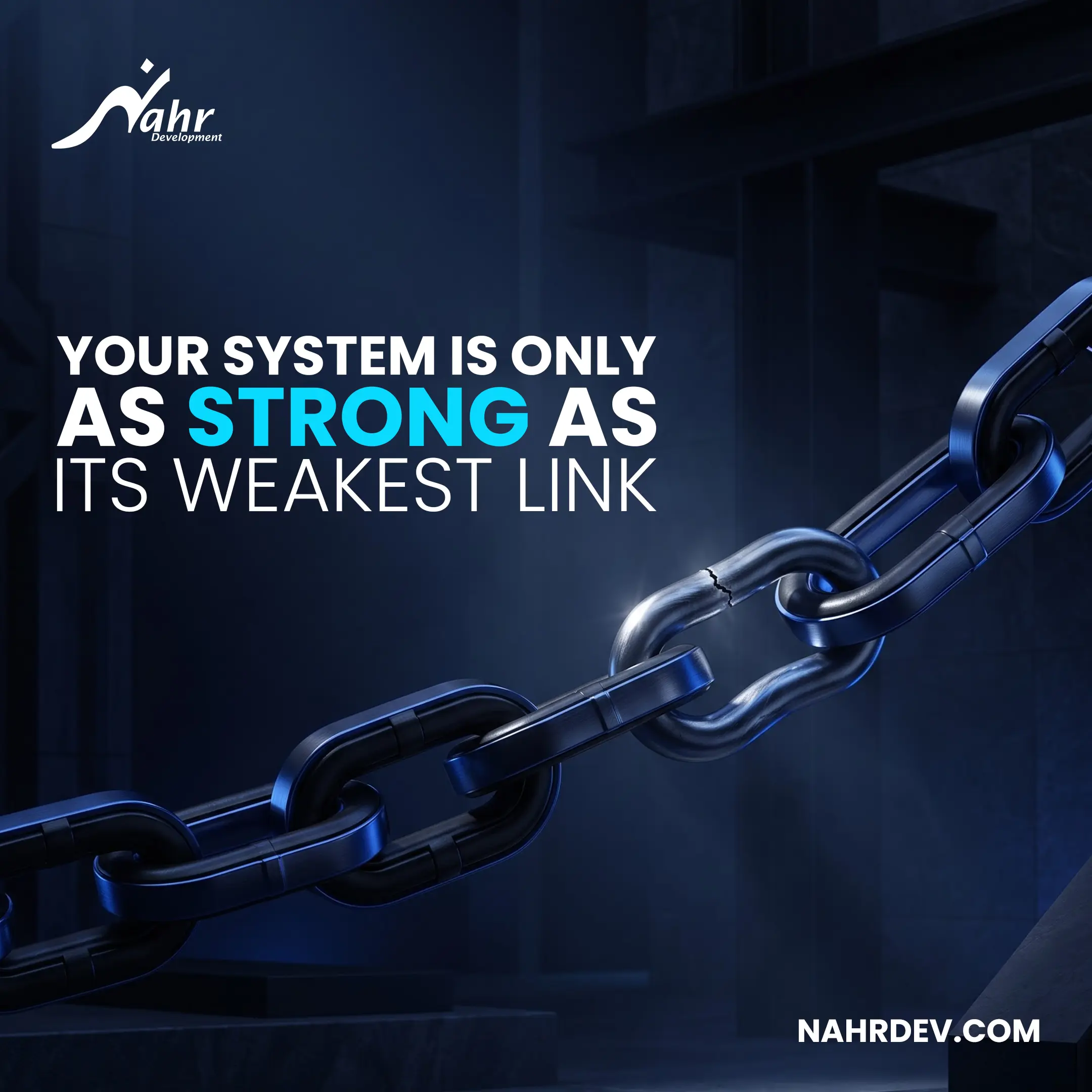
The goal is not to build a system that contains no weaknesses, as this is unrealistic in complex systems. The goal is to know where the risks lie, measure their impact, and prioritize addressing them before the weakest link becomes the factor that limits the entire system’s performance.
What Is Meant by the Weakest Link in a System?
The concept of the weakest link means that a system composed of several interconnected parts can be affected by one of its least capable components. If all services can handle a large number of requests, while a database exists that cannot bear this load, then the database becomes a bottleneck for the entire system.
The same applies to security. You may have strong layers of protection, but a weak authentication mechanism or poorly configured permissions can create a path that allows unauthorized access.
Nor are system weaknesses limited to the technical side. The problem may lie in an operational procedure, the system’s reliance on an external service, a lack of documentation, or the absence of a failure response plan.
Therefore, analyzing system weaknesses must view the system as an interconnected ecosystem, not a collection of independent components.
How to Discover System Weaknesses Before Problems Occur?
Discovering weaknesses requires a methodology, not just waiting for errors to appear. The first step is to draw a clear picture of the system and know all its components and the relationships between them.
You must know how data moves, where it is stored, what services the system depends on, and what happens if one of these components fails.
After that, risks can be classified according to several factors, such as the probability of the problem occurring, its impact on operations, the number of affected users, the speed of detection, and the ease of service recovery.
This analysis helps the team focus on priority risks instead of wasting time improving parts that do not represent a real obstacle to the system.
| Type of Weakness | Potential Problem | Impact on the System |
|---|---|---|
| Technical Architecture | Component unable to handle the load | Slowdown or service outage |
| Database | Unoptimized queries or design | Performance degradation as data grows |
| Security | Unpatched vulnerabilities or permissions | Data leakage or unauthorized access |
| Code | Complexity and maintenance difficulty | Increased development and repair costs |
| External Services | Full dependence on a single provider | Part of the system goes down when the service stops |
Technical Architecture: When the Foundation Is the Weak Point
A platform may work efficiently at the beginning of a project despite problems in the technical architecture. The reason is that the usage volume is limited, and therefore the system’s true constraints do not appear.
But as users, data, and operations increase, bottlenecks begin to emerge. The database may become slow, server consumption may rise, or a specific service may fail under pressure.
Good technical architecture does not mean using the largest number of technologies. On the contrary, good design is what achieves a balance between performance, security, cost, ease of maintenance, and scalability.
Therefore, growth scenarios must be considered from the beginning. What happens if the number of users doubles? What if transactions increase tenfold? What if there is a need for a new service that relies on the same data?
All these questions help discover system weaknesses before they become obstacles to the project’s growth.
Code Quality and Maintenance: The Problem That Appears Late
There is a type of weakness that does not appear immediately after the system launch. The application may be fast and stable, but the internal code is complex and disorganized. With every new modification, development becomes more difficult.
The problem appears when the project needs to add a new feature or fix an old defect. Instead of making a limited change, the team discovers that changing one part affects many other parts.
This is what makes code quality a fundamental factor in the sustainability of any system. Clean, organized code is easy to understand, test, and develop, while accumulated code turns every future change into a risk.
Documentation is also important, especially in projects that last for years. If team members change, new engineers must be able to understand how the system works without relying on the memory of one person.
This is where the importance of choosing the best software company emerges—one that does not treat code as a final outcome, but as an asset that will continue to be worked on after launch.
Security: A Single Weak Point May Be Enough
In systems that deal with customer data, payments, or internal information, security cannot be considered an additional phase implemented just before launch. It must be part of the system’s development cycle.
There may be multiple layers of protection, but a single error in permission management, authentication, or data handling can create a major risk. This is why modern practices rely on security testing and vulnerability discovery during development phases, not just after the project is complete.
Security review includes code analysis, testing applications while running, reviewing external components, and ensuring that permissions grant each user the minimum they need to perform their tasks.
The software components used within the system must also be monitored and updated when known vulnerabilities appear. Security is not a static state; threats change, and therefore protection mechanisms must change with them.
Performance and Scalability: When the System Cannot Handle Growth
One of the most dangerous system weaknesses is being designed only for the current size. The system may achieve excellent performance with a thousand users, but that does not mean it will maintain the same performance with ten thousand or a hundred thousand users.
This is why performance must be tested under different conditions before fully relying on the system. It is not enough to know that the page opens quickly under normal circumstances; you must know what happens when the number of requests rises or the data volume increases.
Load and stress testing can be used to discover the system’s limits and identify the components that need improvement. Continuous monitoring after launch also helps detect performance degradation before it becomes a clear problem for users.
Scalability is not just adding new servers. Sometimes the bottleneck is in the database, in the way the code is written, in an external service, or in the design of a specific process within the system.
Therefore, the source of the problem must be identified before attempting to increase resources. Strengthening the wrong part will not solve the problem if the weakest link lies elsewhere.
Testing and Monitoring: Discover the Problem Before the User Does
Good testing does not only ask: “Does the feature work?” It also asks: “What happens when it doesn’t work?”
Both normal and exceptional scenarios must be tested, including unexpected data input, external service outages, high usage, connection loss, and unauthorized access attempts.
Testing must also not stop at the pre-launch phase. After the system is running, monitoring becomes an essential part of quality management.
Monitoring tools help detect rising error rates, slow response times, resource consumption, and problems in various services. The earlier a problem is discovered, the easier and less impactful its resolution is on the business.
Therefore, a strong system is not one where errors never occur, but one that can detect errors, handle them, and restore service quickly.
The Technical Team: The Weakest Link May Be Outside the Code
It is easy to think of weaknesses as purely technical problems, but the human element can be a decisive factor in system stability.
The absence of documentation, poor communication among team members, unclear responsibilities, or reliance on one person who knows all the system’s details can create significant operational risks.
Short-term technical decisions can also become a burden on the project later. Choosing a quick solution just because it is cheaper today may lead to a much higher cost when expansion or rebuilding is needed.
Therefore, technical decisions must be linked to business goals, and there must be continuous communication between project owners and the engineering team.
How to Choose the Best Software Company to Avoid Weaknesses?
If you are investing in a system your company’s operations depend on, choosing a software company should not be based on price or delivery speed alone. The most important question is: Can the company discover weaknesses before they become a problem?
Look for a technical partner who can explain their engineering decisions, not just execute instructions. Ask about how they handle performance, security, testing, documentation, monitoring, and backup.
- Analysis Before Implementation:
The nature of the business, requirements, and risks must be understood before development begins. - Clear Architecture:
The technical architecture must be designed according to the project’s current and future needs. - Real Testing:
Do not settle for testing basic functions; test stress, security, and edge cases. - Maintainable Code:
Code quality directly affects future development and repair costs. - Post-Launch Monitoring:
There must be a mechanism to detect problems before the customer does. - Clear Ownership:
Rights to the project, source code, and documentation must be clear in the agreement.
A professional company does not just try to make every part of the system work. Its goal is to know where the system can fail, then reduce the probability and impact of that failure.
Nahr for Software Development: Building From Points of Strength
At Nahr for Software Development, we believe that system quality starts before the first line of code is written. Therefore, we rely on understanding requirements and analyzing the nature of the project before making technical decisions.
We focus on building systems that can be developed and maintained, with attention to performance, security, code quality, and user experience. The goal is not just to launch the product, but to build a foundation that can be relied upon as the project grows.
We offer solutions that include mobile app development, alongside e-commerce store development and platforms that require an organized, scalable structure.
We also believe that the relationship with the client should not rely on technical lock-in. Clear ownership, delivery of software assets, and good documentation are part of building a long-term relationship based on trust.
Therefore, when we handle a new project, we do not only ask how to build the required features. We also ask: Where can the system become weak? And what must we do now so that this point does not become a problem later?
Frequently Asked Questions About System Weaknesses
What is the weakest link in a software system?
It is the component or part least capable of handling pressure, whether technical, operational, or human. When this part fails, it affects the entire system’s performance or stability.
How can system weaknesses be discovered before launch?
Through comprehensive analysis of components and relationships, security testing, load and stress testing, code reviews, and studying growth scenarios before deployment.
Does a system need to be completely free of weaknesses?
No. The goal is not to eliminate every weakness, but to know where the risks lie, measure their impact, and reduce the probability and severity of failure.
Are system weaknesses only technical?
No. Weaknesses may be operational, such as unclear procedures, or human, such as reliance on a single person or poor documentation.
How do I choose a software company that avoids weaknesses?
Look for a company that analyzes before building, explains its engineering decisions, tests for stress and security, documents its work, and provides monitoring after launch.
Conclusion: Strengthen the Weakest Link First
Any system contains weak points. The difference between a successful system and a failing one is not the absence of weaknesses, but the ability to discover them early and deal with them before they become crises.
Strengthening the weakest link does not mean ignoring the rest of the system. It means knowing where the priority lies, and making decisions based on a clear understanding of risks and their impact.
Whether you are building a new system or developing an existing one, ask the hard questions before the market or the users ask them for you. Because the system that ignores its weak points today will be forced to face them tomorrow, at a much higher cost.